
The aquarium of sound
Hums, thresholds, and the work of hearing

The peak of spring arrives first through the eye and the nose. Daffodils and tulips push up through the thaw, followed by the brief, improbable pink of cherry blossoms and magnolia suspended over streets and yards, all of it carried on the smell of wet soil and fresh grass shoots by a humidity that hangs in the air with an almost sweet persistence. Longer days and warmer nights draw us outdoors, as we settle into something that feels immediately and inexplicably right.
Evenings carry the first hint of something else lingering in the air, though it doesn't quite resolve. Neighbours’ voices swell and recede across fences, a television leaks through an open window, and traffic passes in uneven waves that crest with the rumble of rising RPM. This too seems right, as though the city itself has eased open again after a long winter its residents spent darting between enclosures.
As night takes hold, yards and balconies go quiet. What remains of the urban soundscape is now filtered through windows left open to gather the temperate air. Traffic thins and the small collisions of the day, from doors to dishes to creaking stairs, fall away one by one. What remains isn’t silence so much as a clearing.
And in that space, it rises. It’s barely noticeable at first. You need time to adjust to the calm before it arrives in a low, continuous presence so fully braided into the atmosphere that it seems as though it’s a condition of the hour.
The hum.
From the quiet of the bedroom, it first takes on the shape of something nearby—perhaps a fan or air purifier—until it settles just beyond the window. Like a rainstorm that never lands, it’s a low-frequency, steady drone without any distinct source. Gathered in its thrum is the continuous procession of traffic moving through the night, every tire turning along the highway, the low buzz of hidden transformers, distant freight crossing railway lines, and the slow exhaust of HVAC stacks.

This aquarium of sound gathers into a single field, a convergence that softens into something like white noise, broken only occasionally by a sudden acceleration or a passing siren that rises as quickly as it disappears into the mass.
The hum sits relatively low in the spectrum, typically in the range of 80 to 200 hertz, where sound behaves like a quiet presence. At these frequencies, waves travel further, bending and spreading through the built environment.
On a warm night in May, a layer of warmer air can sit above cooler ground air, bending sound back toward the surface rather than allowing it to disperse upward. Humidity thickens the medium, helping low-frequency waves maintain their coherence across longer distances. With fewer competing sounds, the city’s baseline becomes newly legible.
In a place like Toronto, the primary driver is the highway network: the 401, the Don Valley Parkway, the 400, the 427. Each operates as a linear source, emitting a constant stream of low-frequency energy. At a distance of several kilometres, those streams overlap and merge, suspended in the night air, arriving as a sustained band that distills urban life into a low wash of sound.

The hum rarely carries much past spring. By the time the air conditioner turns on and the windows close, a new sound takes hold, one that’s closer, more immediate, and marked by the steady cycle of a compressor. Where the hum draws the ear outward, placing it at the edge of a vast field, the air conditioner returns it to the confines of the more private world of the backyard.
Even before that shift, something else has already begun to happen. The ear adjusts. As the season settles, perception dulls. What first rose into focus settles again into the background, absorbed through repetition until it no longer presents itself. The hum remains, but familiarity presses it flat, returning it to the city from which it briefly emerged.
It starts inside the house.
A vibration more than a sound, something present that you can’t place. You move from room to room trying to locate it. Is it the refrigerator? A fan left running? Something wrong with the furnace? You turn things off one by one, and still it remains.
Outside is no different.
It’s a steady, low presence that seems to come from everywhere at once, as though the ground itself were holding it. People describe it in approximations. A diesel engine idling somewhere in the distance. Underground drilling. Faulty wires buzzing. It’s a deep, monotonous hum that carries through walls and floors. Sometimes it’s heard, sometimes felt, and often both at once. Eventually, sleep becomes difficult as the body strains to locate what the ear can’t fix in place.

In Windsor, this persisted for years. The frequency sat lower than the band of urban noise produced by traffic and transformers, closer to the threshold where sound gives way to vibration, often around 30 to 40 hertz. At that depth, it travels easily, slipping through structures, folding around obstacles, carrying further than expected. Residents formed groups, set up recording devices, and traced the sound across neighbourhoods, but the source remained elusive.
And so the theories stacked up. Some attributed the hum to the Detroit salt mines, deep beneath the river, their machinery carrying upward through earth and water. Others cited natural gas pipelines under pressure, moving unseen across the region. Military sonar testing also gained traction, which, given the strangeness of the situation, didn’t seem entirely far-fetched. Each theory attached briefly, offering the possibility of placement, then inevitably loosened when the sound refused to comply.
Eventually, the source was narrowed to blast furnaces on Zug Island, just across the Detroit River. The heavily restricted site was a long-suspected culprit, but it was only when operations ceased and the furnaces went quiet that the hum stopped. No statement was issued. No formal confirmation was ever offered. The source was inferred only through absence. What had been everywhere at once was finally given a place by being erased.

Elsewhere, it continues without origin or explanation.
In Taos, New Mexico, reports of a similar low-frequency presence have persisted for decades. The descriptions echo one another: a distant engine, a pressure in the ears, a sound that sits just beyond articulation. Investigations have come and gone. Explanations surface and recede. Still no single source holds. And so it remains unresolved, held in place by its own persistence.
A hum that can be located settles into the world, even if it takes years to get there. One that does not, resists that process entirely, remaining fixed at the surface of perception, where it cannot be absorbed, only endured.
The quietest place on earth sits at the edge of an industrial park across from a liquor store in suburban Minnesota. The building is mostly windowless, covered in ivy and surrounded by a layer of shrubs and other greenery that allow it to retreat unassumingly into the surrounding landscape. You’d be forgiven for driving right by, never knowing the remarkable things that take place inside Orfield Laboratories, home to one of the world’s most effective anechoic chambers.
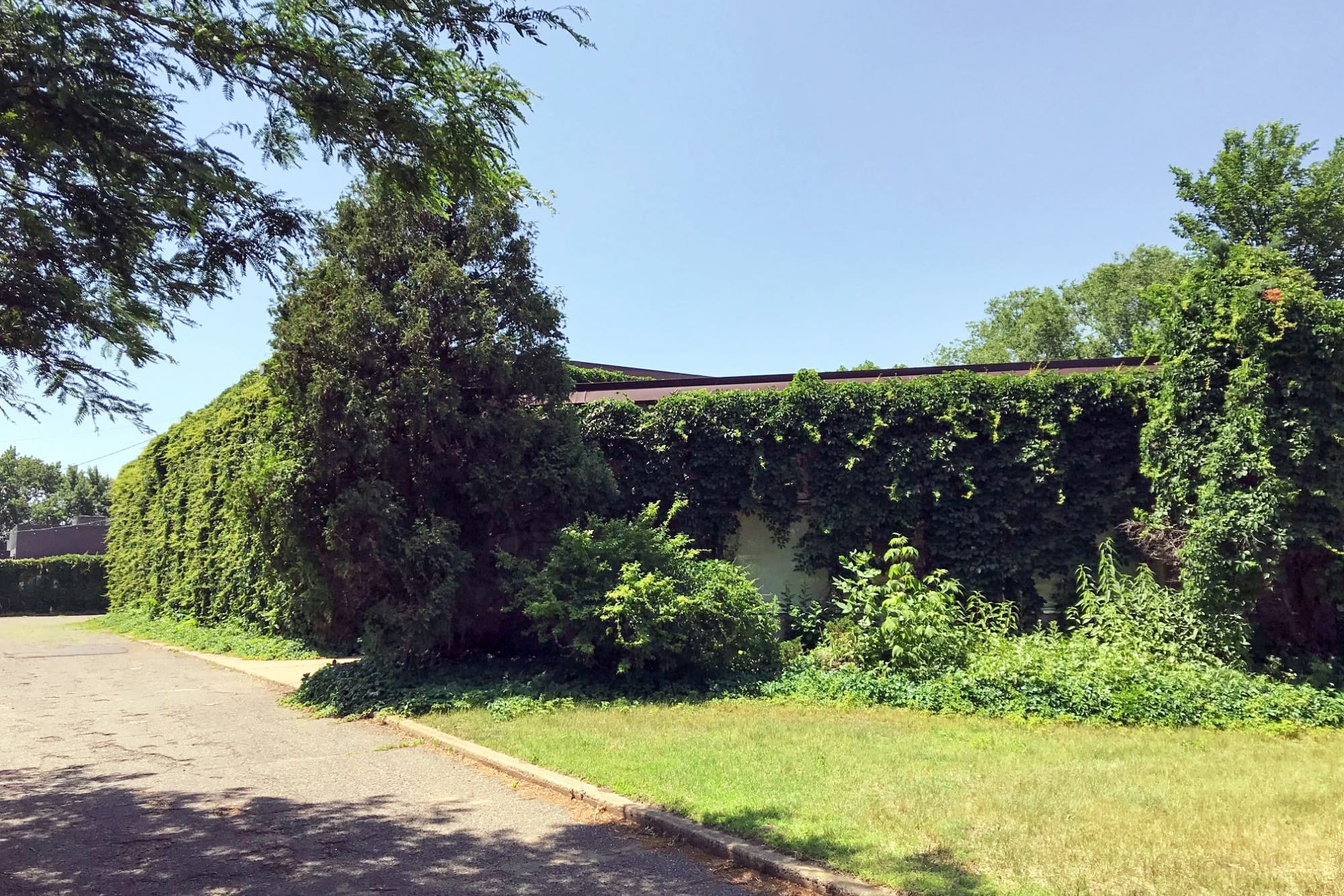
Originally a music studio—Funkytown, Lipps Inc.’s 1980 disco-funk hit, was recorded here—the building is now home to a multi-sensory research lab where employees work across disciplines like architecture and product development to benchmark perceptual comfort in both the built environment and in response to products like dishwashers and mattresses. One way or another, you’ve likely benefited from the work of the lab’s founder, Steven J. Orfield, whose efforts have helped reduce the intrusion of unwanted sound in everyday life.
The anechoic chamber at Orfield is anything but a secret. A few years ago, it began circulating widely online, helped along by a TikTok rumour that there was a multimillion-dollar prize for whoever could last the longest inside. The concept seems less ridiculous when you learn that the company itself once touted the “Orfield Challenge,” charging $600 an hour to anyone willing to attempt a record for time spent in total audio deprivation.
It’s an alluring challenge—and prime fodder for the media—because it promises something so completely out of the ordinary that it tests the limits of perception itself. Reflections published on Orfield’s own website describe the space as “sacred,” but it’s also widely reported that, in the absence of external sound, the body begins to register with unusual clarity: the circulation of blood, the faint articulation of joints, breathing. Even the act of smiling becomes audible when everything else falls away.
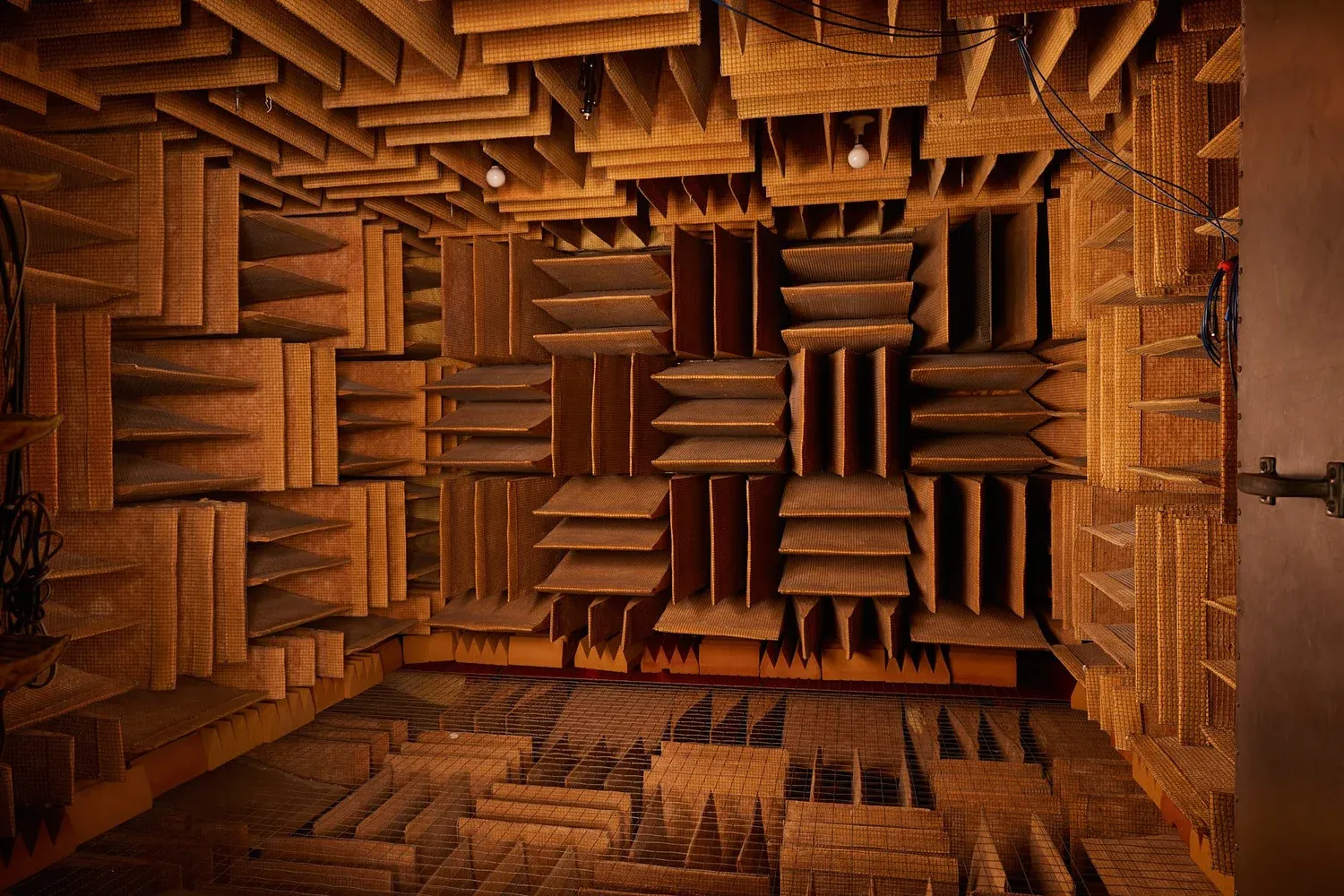
What an anechoic chamber lays bare is not silence but the degree to which we are inundated with sound. Even places we tend to think of as quiet are in fact alive with it.
The bedroom at night, even before its windows are opened to welcome the hum of the nocturnal city, sits at roughly 25 to 30 decibels. A subway platform buried deep beneath the city rarely drops below 60, even in the absence of a train. While you wait, you’re hit with a compendium of electrical gain, HVAC systems, distant movement, and passenger murmur held in place by the hard surfaces of the underground. Even the cottage dock is defined by a complex soundscape: water lapping against wood, leaves shifting in the trees, toads and crickets, the distant passage of a boat, and the occasional loon.
Outside of the chamber, what we take for silence is better understood as successful filtering. The ear continues to receive, but the brain keeps the world livable by demoting most of what it encounters to the background. Silence, in other words, is rarely a property of the world. If asked to name the quietest place I’ve been, I might offer Wenda Lake in Algonquin Park. What I remember most, though, is not its stillness but its singularity: a constant, high wash of wind moving through leaves and reeds, unbroken by birds, insects, or any other sign of life.
We’re so accustomed to sound that its removal is unsettling. Regardless of the current record for time spent in an anechoic chamber, lasting even a few hours is a significant achievement. For humans, sound is the default condition. What we call silence feels less like absence than a disruption. The intimacy with which we begin to register our own bodies becomes discomfiting.

In the right measure, sound situates and soothes us. When sleep proves difficult, we often reach for white noise to smooth the edges of what’s already there, to settle the mind into something continuous and manageable. And that cottage dock—it feels peaceful not because it’s quiet, but because of the orchestra of natural sounds that holds us in that particular landscape and moment in time.
Out in the country, tucked tightly in our tin bungalow, the night winds down in stages.
I slip inside while the last of the evening lingers. Low voices, the faint residue of the fire still in the air, and distant chatter from a neighbouring property. As I settle into bed, the sounds gather, closer now, contained in the small space. Someone brushing their teeth at the sink, the pressure of the tap alternating with the soft, irregular rhythm of the final bedtime routine. Beyond the bedroom door, a phone plays quietly, the muffled rise and fall of voices I can’t quite make out. Beside it, a restless turning from one of the beds, sheets shifting, a body refusing stillness.
Then, gradually, each of these begins to fall away.
The phone goes silent. The movement settles. In the pause that follows, the last crackle of the fire outside returns faintly, collapsing in on itself. Breathing becomes audible. First mine, then hers, deepening beside me, steadying into sleep. A moment later, from down the hall, the lightest trace of a snore, intermittent, almost tentative, but enough to mark the crossing. Even with teenagers, the arrival of sleep comes as a relief.
Then the crickets arrive.
They’ve been there all along, holding a steady chorus just beyond the walls, but only now do they come into focus, rising to meet the quiet that has made space for them. The sound comes in an even interval, continuous, without urgency. In this place, it is the character of night itself.
I fall asleep to the sound of breath and the steady roll of insects. Everything in its right place.
